
Workday - Adaptive variance root-cause + narrative (demo)
Workday → Data → Variance Drivers → Flowise Narrative (variance_rootcause_model)

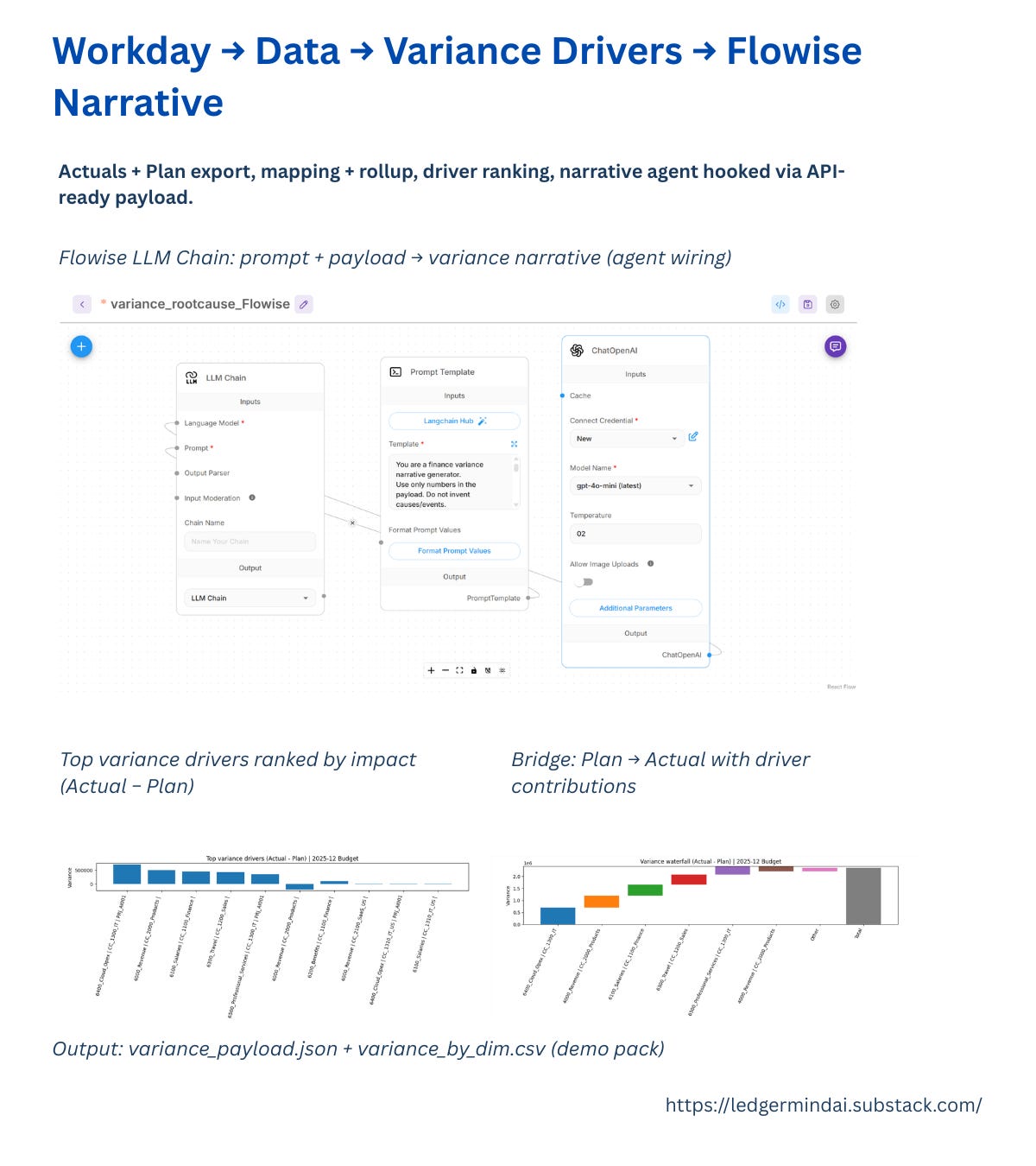
I tested: can I stop the “chart says one thing, commentary says another” problem by forcing everything to come from one table.
I did this because variance reviews waste time when two different cuts of data are used. People end up reconciling instead of deciding.
This was a practice run on synthetic Actuals and Plan shaped like a Workday export and an Adaptive Planning extract. The point was to test the flow and the outputs.
Variance was defined in the simplest way at the lowest grain: actual − plan, after mapping and rollups across company, account, cost center, product, and project.
I produced one variance table and used it for three outputs: a ranked top-drivers view, a Plan-Actual waterfall, and two files- a flat table for checking and a small payload (totals + top drivers + flags) for the write-up.
The small payload helped. It kept the write-up tied to the same numbers as the visuals. The ranking and the waterfall reconciled because they were reading the same table. The same payload shape also works across periods and versions.
What slowed me down was model access in my setup. Hosted Flowise hit quota limits. Local runs hit memory limits. The data side held, but always-on narrative needs stable model access.
Usable for planning/controls? Yes, as a way to keep variance review consistent and audit-friendly. No, for automatic commentary everywhere until model access is stable.
Next run: split by currency (or convert to a reporting currency) and add a simple reason-code mapping so driver buckets stay consistent month to month.